
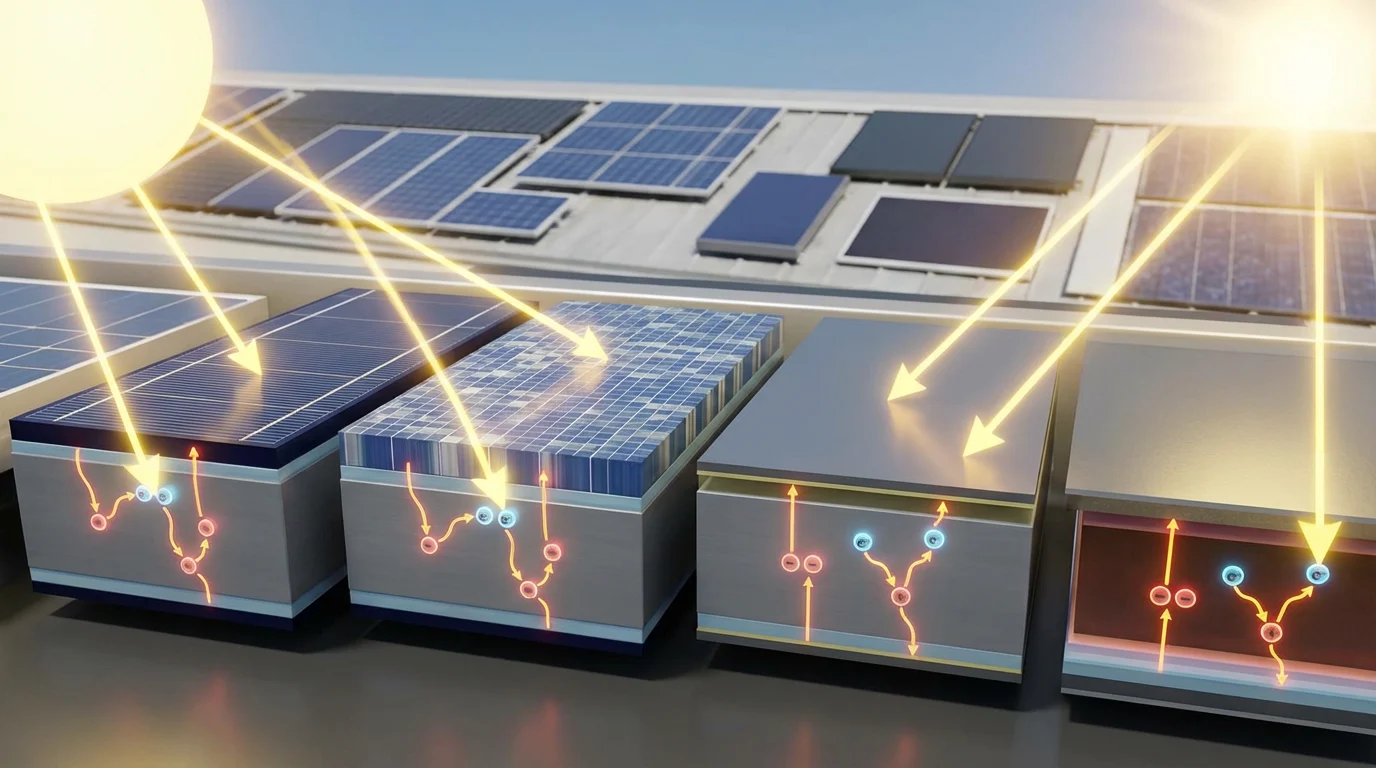
The Basic Science of Photovoltaic (PV) Solar Cells
95% of the modules sold today are made with Silicon, which is the most common semiconductor material. It is also used in computer chips. Thin-film Solar cells are another technology used. Cadmium Telluride (CdTe) and Copper Indium Gallium Diselenide (CIGS) are two main types of semiconductors used in this technology. CdTe is the second-most common PV material after silicon.
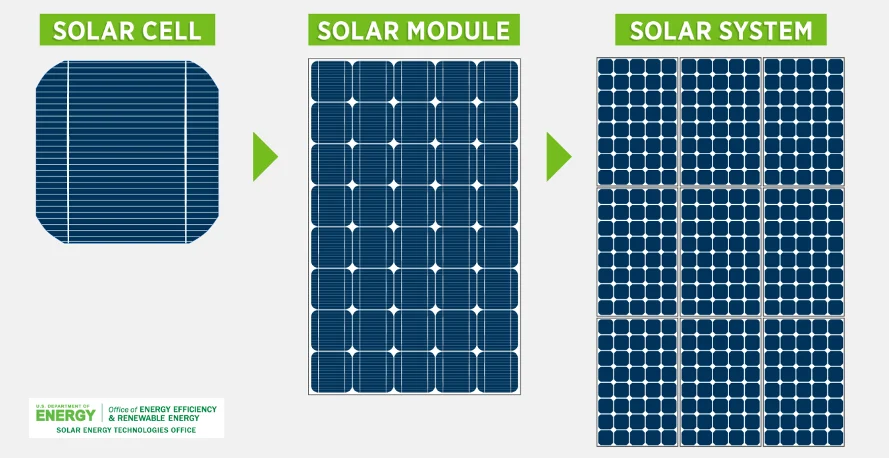
A picture reference from the U.S. Department of Energy – https://www.energy.gov/eere/solar/articles/pv-cells-101-primer-solar-photovoltaic-cell
Solar cells contain a material that conducts electricity only when sunlight hits it, absorbing the light, and transferring the energy to negatively charged particles called electrons. The electrons flow through the semiconductor as electrical current because other layers of the PV cell are designed to extract the current from the semiconductor. Then the current flows through metal contacts—the grid-like lines on a solar cell—before it travels to an inverter (Read our article – ‘What is an Inverter’).
The inverter converts the direct current (DC) to an alternating current (AC), which flows into the electric grid and, eventually, connects to the circuit that is your home’s electrical system. As long as sunlight continues to reach the module and the circuit is connected, electricity will continue to be generated. Outside, environmental conditions like heat, dirt, and shade can reduce conversion efficiency, along with other factors. Technology keeps improving to enable high operational efficiency over many years with very low maintenance. Bifacial solar cells are double-sided to capture light on both sides of a silicon solar module. This increases the solar electricity production. In Texas and other places, periodic rain is credited with keeping solar panels relatively clean.
YouTube video from @SabinCivil provides a good visual on the making of a Silicon photovoltaic wafer and electricity generation process:
The Conversion Efficiency of Sunlight to Electricity
Solar panel conversion efficiency, also known as power conversion efficiency (PCE), is the percentage of incident sunlight that a solar panel converts into usable electrical energy. It’s calculated by dividing the panel’s output power by the input power (sunlight) and multiplying by 100. The efficiency is typically expressed as a percentage.
High-end commercial solar panels have an efficiency rating of over 20%. This implies that one square meter of the panel area produces over 200 watts of electricityunder standard test conditions (in-plane solar irradiance of 1,000 W/m2 at photovoltaic cell junction temperature 25°C). For additional details, see the U.S. Department of Energy publication – https://www.energy.gov/sites/default/files/2022-02/understanding-solar-photo-voltaic-system-performance.pdf.
Please note that the reported efficiency of a solar wafer is higher. As a solar cell gets assembled into a solar wafer, which eventually gets assembled to produce a solar panel that is installed on a rooftop, the resulting efficiency rating decreases a little due to the various electrical losses in the connection process.
What are the Main Technologies behind Commercial Solar Panels
High-end panels are Monocrystalline silicon solar panels. This article focuses on Silicon technologies. The Cadmium Telluride (CdTe) solar panel description could be found at https://www.firstsolar.com/en/Technology/CadTel
Monocrystalline panels made from a single pure silicon crystal that cut into several wafers has a characteristic dark black color. The use of pure silicon also makes monocrystalline panels the most space-efficient and longest-lasting among other (polycrystalline, etc.) solar panel types.
PERC – Passivated Emitter and Rear Cell Solar panels
This technology adds a passivation layer in the rear surface of the cell that enhances efficiency in several ways:
- PERC cells are traditional monocrystalline or polycrystalline silicon cells with an added rear passivation layer.
- This back layer reflects unabsorbed sunlight back into the cell for a second chance at energy conversion.
- It also reduces electron recombination, which improves efficiency—especially in low light or high heat.
✅ Key Benefits:
- Typically 20–22% efficiency
- Low-cost upgrade to standard silicon cells
- Works well in hot, sunny climates (like Texas)
- Better performance in low-light or angled light conditions
TOPCon (Tunnel Oxide Passivated Contact) Solar panels
- Builds on PERC by adding a thin tunnel oxide layer and a doped polysilicon layer on the rear.
- This structure improves electron pass-through and reduces recombination far better than PERC.
- Enables more efficient charge collection, especially on the back side.
✅ Key Benefits:
- Higher efficiency: 22–24% and improving
- Better long-term performance (less degradation)
- Stronger results in high-temperature and low-light conditions
- Often used in n-type silicon cells (more stable, less light-induced degradation)
HJT (Heterojunction Technology) Solar Panels
- Combines crystalline silicon with amorphous silicon layers on both sides.
- Reduces energy loss dramatically and performs exceptionally well in high heat and low light.
- Naturally bifacial — generates energy from reflected light on the back side
✅ Key Benefits:
- Highest efficiency potential (22–25%+)
- Outstanding performance in heat and low-light conditions (e.g. mornings, evenings, cloudy days)
- Very low degradation (as little as 0.25% per year). Based on n-type silicon.
- Minimal light-induced degradation (LID) compared to PERC or TOPCon
- Lower operating temperature, improving system lifespan and output
Feature | PERC | TOPCon | HJT |
| Efficiency | 20–22% | 22–24% | 22–25%+ |
| Base Silicon Type | p-type | n-type | n-type |
| Temperature Performance | Good | Excellent | Best-in-class |
| Low-Light Performance | Good | Very Good | Excellent |
| Degradation Over Time | ~0.45%/year (LID) | ~0.3%/year (low LID) | ~0.25%/year or lower (very stable) |
| Light-Induced Degradation | Moderate | Low | Near zero |
| Cost | Lowest | Moderate | Highest (but falling fast) |
| Commercial Maturity | Very mature | Rapidly growing | Emerging, high-end market |
| Bifacial Compatibility | Limited | High | Very High |
| Production Complexity | Low | Moderate | High (dual-sided, precision layers) |
Examples of Commercial Solar Panels
All the companies cited below make various solar panel products for residential and utility-scale usage.
- SEG has a solar panel manufacturing plant in Houston, Texas. Their Yukon N type solar panels (https://www.segsolar.com/products/yukon-n) have a reported 23.03% module efficiency.
- Sirius PV USA also has a manufacturing plant in the Houston, Texas area. Their ELNSM54M-HC Series (https://siriuspv-usa.com/images/ELNSM54M-HC-DC-BS%20&%20DC-BS-E%20&%20DC-BS-E-J.pdf) has a reported 21.25% efficiency.
- Mission Solar has a solar panel manufacturing plant in San Antonio, Texas. Their MSE PERC 108HC solar panels (https://www.missionsolar.com/wp-content/uploads/2024/07/MSI-PERC-108HC.pdf) efficiency is reported in 20.5-21.0%
- Q-Cells: Q.PEAK DUO BLK ML-G10+ SERIES (https://media.qcells.com/v/V3EPlQau/) are rated at 21.1% module efficiency.
- REC, in their product ALPHA® PURE-RX SERIES (https://www.recgroup.com/sites/default/files/2025-01/Web_DS_REC%20Alpha%20Pure-RX_EN.pdf) reports using HJT technology with reported efficiency in the range of 21.6% – 22.6%
Solar panel efficiency rating is one of the several criteria that should be considered in the solar panel selection process. Their stated reliability over years of usage, warranty, size, cost, etc., are some other selection criteria.
Big Bright Solar professional experts will answer your questions and recommend the ideal products for your house and personal preferences. Solar panel cost, along with inverters and batteries, is figured in the total system cost. All of this can avail of tax credit benefits. Read our expert articles on solar tax credits – ‘Solar Tax Credits Reduce Your Net Cost’ and 5 Steps to Estimating the Size of a Solar System for Your Home
References:
https://solarmagazine.com/solar-panels/heterojunction-solar-panels/