

What are Tax Credits
To promote clean energy adoption, which includes Solar electricity generation and associated battery storage, the Federal government and various state governments offer tax credits (https://www.energy.gov/sites/prod/files/2021/02/f82/Guide%20to%20Federal%20Tax%20Credit%20for%20Residential%20Solar%20PV%20-%202021.pdf). The federal government tax credits could be 30% of the installed cost of the solar system or higher. Tax credits imply that, in most cases, the end-of-year taxes owed are reduced by the amount of the tax credits.
This is a significant benefit for any homeowner or commercial business considering solar installation to offset their electricity costs. The amount of tax credits reduces the net cost of the solar system. Hence, it shortens the payback time of your system.
Big Bright Solar has partnered with a nationally recognized Solar Tax Credits Specialist CPA firm to help maximize tax credits and other incentives. This could result in upto 50%* off the cost of your Solar System. Not everyone qualifies for tax credits. Incentives and tax credits can vary with your system configuration, location, and other factors. Specialist tax professional should be consulted for advice.
What Tax Credits are Available for Solar Installation
Following are the different tax credits:
Base Investment Tax Credit (ITC) – 30% Tax Credit
The Base ITC (Investment Tax Credit) is a federal incentive that allows homeowners and businesses to deduct a percentage of the cost of installing a solar energy system from their federal taxes. As of 2025, the ITC is set at 30% of eligible costs for both residential and commercial solar installations. This credit applies to the total system cost, including equipment and installation, and can be claimed by those who own (not lease) their solar system.
Bonus Adders: Domestic Manufacturing, Energy Community, and Low-Income
Several “adders”-additional bonus credits on top of the base ITC-for projects that meet specific criteria could apply. These adders further increase the total tax credit available for a solar project.
1. Domestic Content Adder
- What it is: A bonus ITC of up to 10% for solar projects that use a sufficient percentage of U.S.-manufactured components, such as steel, iron, solar panels, racking, and inverters. This adder is designed to support U.S. manufacturing and strengthen domestic supply chains.
- Requirements: Projects must meet specific thresholds for domestic content (currently 40% for ITC projects), meaning a certain portion of the total cost of manufactured products and construction materials must be sourced from the U.S.
- Earlier in 2025, the U.S. Department of the Treasury Released Guidance on Domestic Content Bonus for Clean Energy Credits – https://home.treasury.gov/news/press-releases/jy2788
2. Energy Community Adder
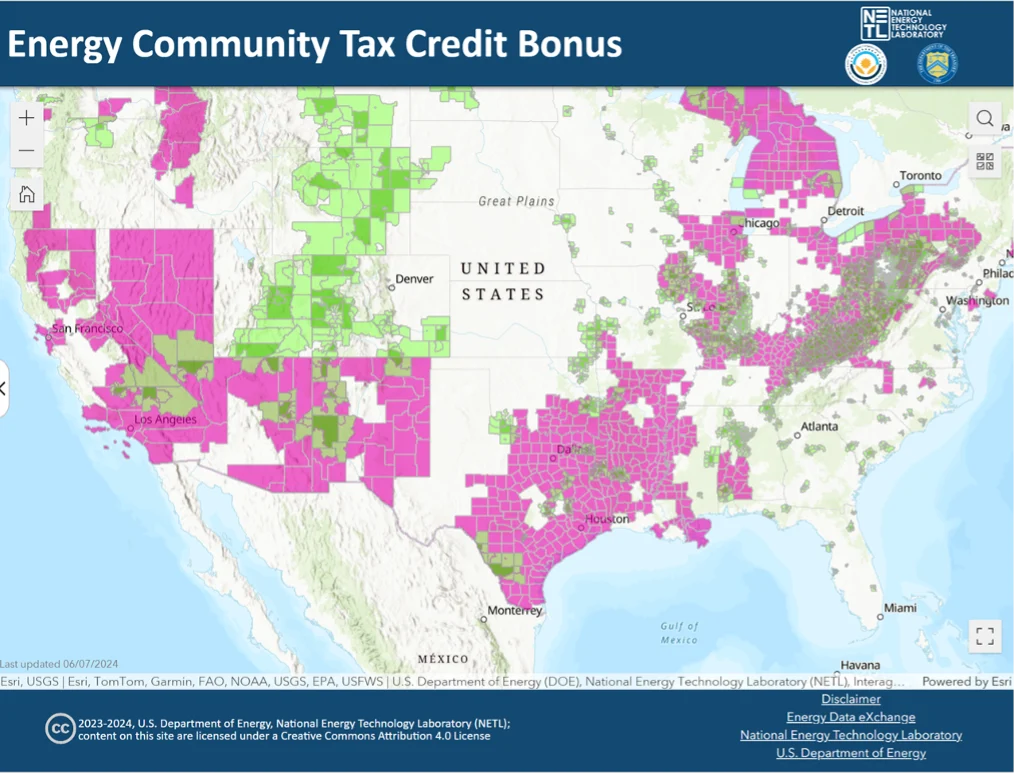
- What it is: An additional 10% ITC bonus for projects located in designated “energy communities.” See the DOE map below. This adder incentivizes clean energy investment in regions transitioning away from fossil fuels, supporting economic development and job creation.
- Definition: Energy communities include areas with significant employment or tax revenue from fossil fuels (like coal, oil, or gas), or areas with high unemployment and a history of fossil fuel industry presence.
3. Low-Income Adder
- What it is: For certain solar projects serving low-income communities or located on qualified low-income residential buildings, additional ITC bonuses are available. This adder aims to expand access to clean energy in underserved and disadvantaged communities
- Details: The low-income adder can be up to 10% or 20% extra, depending on the project type and location.
- 10% bonus: For projects located in low-income communities or on Indian land.
- 20% bonus: For projects that are part of qualified low-income residential building projects or qualified low-income economic benefit projects.
Summary Table: ITC and Adders
Incentive Type | Additional Credit | Key Criteria |
Base ITC | 30% | All eligible solar projects |
Domestic Content Adder | +10% | Sufficient U.S.-made components |
Energy Community Adder | +10% | Located in designated energy communities |
Low-Income Adder | +10% or +20% | Serves low-income areas or residents |
Note: These adders can be stacked, so a project meeting all criteria could receive up to 50% or more in total ITC, dramatically reducing the net cost of solar installations.
Reference for similar credits for the business owner – https://www.energy.gov/sites/default/files/2024-02/508%20Federal%20Solar%20Tax%20Credits%20for%20Businesses_Feb24.pdf
How to Claim the Tax Credits
The installed solar system documents from your installer serve as the starting point to show the total cost, configuration details, date of operation, etc.
IRS has special tax forms such as the Form 5695 (https://www.irs.gov/pub/irs-pdf/f5695.pdf), Form 3468 (https://www.irs.gov/pub/irs-pdf/f3468.pdf), etc., to fill in the information. Please consult your solar installer and tax or legal professional for the most current advice.
Big Bright Solar has partnered with a nationally recognized Solar Tax Credits Specialist CPA firm to help maximize tax credits and other incentives for our customers. Make the most of the available tax credits to reduce your net cost of a solar system.
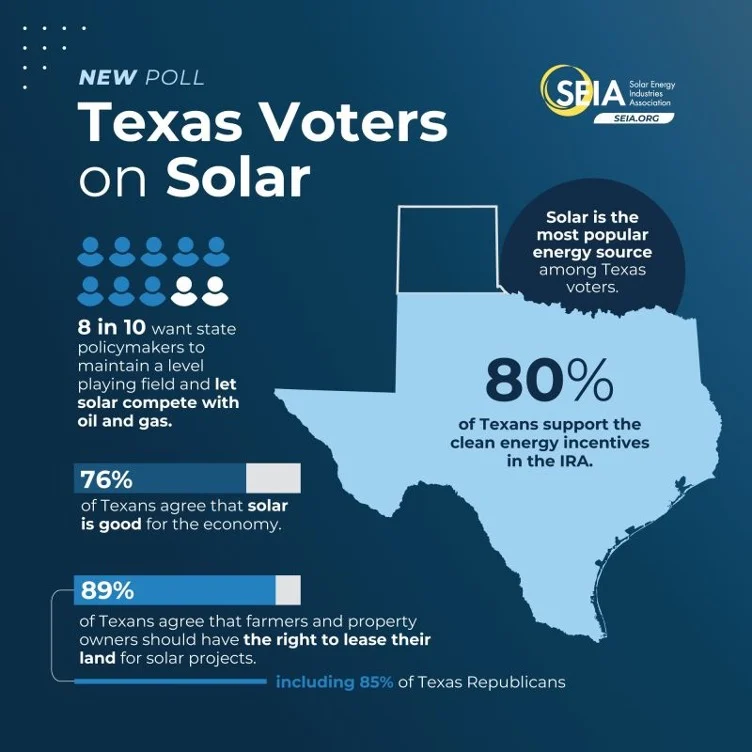
Strong Support in Texas for Clean Energy Benefits and Policies
Consistently strong support among Texans has made Texas a leader in generating solar electricity.
Several references have reported this –
Gain understanding about the Solar system through our expert articles on the Solar panel technology (Technology Behind Popular Solar Panels and Their Comparison) and sizing a Solar system (5 Steps to Estimating the Size of a Solar System for your Home).