

Many factors go in accurately designing a solar system for each house. Big Bright Solar professionals will work with you to design a system that works for you, that factors your house location and roof layout, your preferences, and meets your budget.
This article provides an overview of key steps –
1. Estimate Daily Electricity Consumption
The best place to look at your electricity consumption is your electricity bills. This is reported in kWh (kilowatt hours). It is good to look at the last 12 months. As an example, if your 12-month usage is 14,000 kWh, then your daily consumption is estimated as
(14,000 kWh yearly)/(12 months x 30 days) ~ 40 kWh per day
2. Analyze your Sun Exposure
Though South or South-West roof direction is considered ideal, many factors such as the house location, roof angle, shading, or direct sunlight obstruction, which is also known as the shading analysis, etc., go into analyzing the solar electricity production potential of your roof. Big Bright Solar uses advanced computerized models to come up with an accurate estimate.
The following map from NREL at https://www2.nrel.gov/gis/solar-resource-maps is a useful reference to know how the peak sunshine intensity varies across the country.
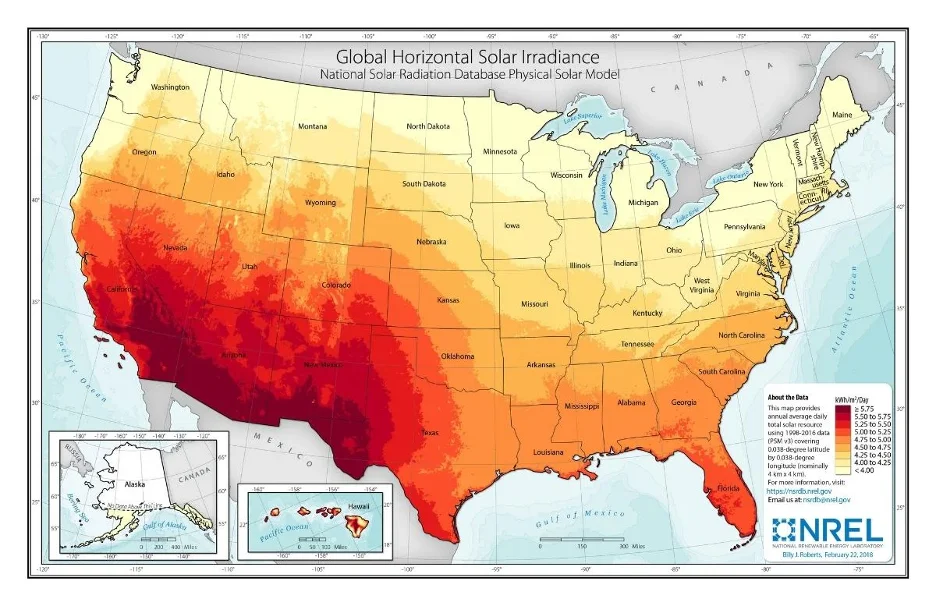
Texas gets about 4.5 to 6 hours of peak sunshine. Lets use a midpoint of 5 peak sunshine hours for this example.
3. Estimate the Size of the Solar Panel Array
Using the example of about 40 kWh daily electricity consumption and 5 peak sunshine hours available, the system size required would be

NREL provides a basic estimator for the solar energy production of grid-connected photovoltaic (PV) systems https://pvwatts.nrel.gov/index.php on their website for anyone to use.
The 8 kW (or 8,000 watts) estimate in this example is increased to allow for some extra buffer to account for solar panel ageing, overuse potential (one may be considering buying an EV car or adding an extra freezer, etc., that would increase the electricity consumption), inverter efficiency and other factors. Big Bright Solar’s computer tools account for this.
It could be decreased if a homeowner wants to use Solar to offset only a portion of their full daily electricity consumption and rely on drawing from the utility grid for the rest (Read our article explaining Net Metering – Solar Electricity Buyback – Net-Metering Explained). We offer our professional advice and factor in your personalized choices in building your ideal solar system.
4. Estimate Number of Solar Panels
There are many solar panel choices ranging from 300 watts to 450 watts per panel. They differ in size, cost, and other factors. Big Bright Solar will advise you on optimal choices for your home. For this example, if we use 400-watt panels, the number of panels required will be

5. Estimate Battery Size
The battery requirement depends on how many hours or days of backup are required. In this example, if we need a full day of electricity supply, a 40 kWh battery is required. Alternatively, if half a day of electricity storage suffices, a 20 kWh battery will be required. Similar to the solar panels, each battery, depending on the manufacturer and the model, could be rated for 5 kWh to 15 kWh.
Therefore, in this example, if 12 hours of electricity storage is needed, which would be 20 kWh, one could use 2 – 3 batteries.
Big Bright Solar professionals will assess and recommend an optimal battery size based on the outage data in your area and your personal preferences. The battery cost factors in estimating the tax credits. Read our article explaining the Solar tax credits – ‘Solar Tax Credits Reduce Your Net Cost’